
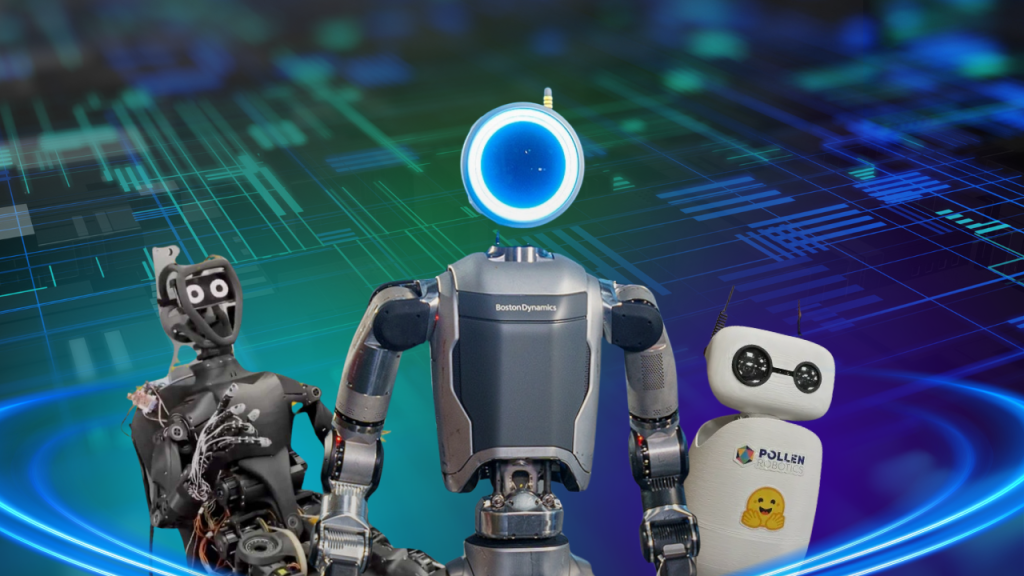
Last week, robots went from looking cool to doing real work, and doing it well. Two major updates are making headlines: one about a super-skilled robot that can fix car parts, and another about low-cost bots you can actually afford. This matters a lot more to your business than you might think.
You might have seen Atlas before, the robot that runs, jumps, and does backflips. But now, Atlas can do something even better: work like a pro in messy, real-life situations.
Boston Dynamics gave Atlas a new “perception system.” Think of it like giving the robot a brand-new brain and a sharp pair of eyes. Now, it can tell the difference between a shelf, a car part, and a random object on the ground, instantly.
In a test, someone kept moving the shelf while Atlas was working. The robot paused, adjusted, and kept going. Another time, a loud noise happened behind it. Atlas turned, found the problem, picked it up, and fixed it, without being told what to do.
That’s not science fiction. That’s real-time problem-solving.
This kind of robot can handle hard, physical jobs with zero complaints. In the future, robots like Atlas could help with tasks in repair shops, warehouses, or manufacturing, saving time and reducing errors.
Atlas is remarkable. But it’s not something most businesses can buy. It costs more than a fancy car. That’s where Hugging Face comes in with two new robots that cost less than a laptop or desktop computer.
Hope Jr. is a full-size humanoid robot that can move like a person. It has 66 motors, which means it can turn its head, wave, pick things up, and maybe even shake your hand one day. Price? Around $3,000.
Reichi Mini is small enough to sit on your desk. It talks, listens, and connects to smart AI models like ChatGPT. It’s meant for testing how AI can interact with the real world, and it costs just a few hundred dollars.
Hugging Face is making these robots open-source. That means anyone can build, test, and improve them. They’re also working with real developers and adding data from their robot studio to make these machines smarter every week.
These aren’t toys. They’re early-stage tools for customer service, front-desk help, inventory checks, and more. You could use one in your shop or office in just a few years, without hiring another person.
You don’t have to be a tech genius to understand what’s coming. Here’s how this new AI could affect your business:
Robots won’t take every job. But they will take the boring, slow, or risky ones. Need someone to organize shelves, check deliveries, or clean up? That job might go to a bot.
Before, only giant companies could afford this. Now, companies like Hugging Face are opening the doors for everyone. Small businesses like yours can test, explore, and benefit early.
Even without a robot, you can use smart tools. Automate your scheduling. Use AI chatbots. Try software that sends follow-up emails or tracks customers. These are the first steps to running a smart business.
These cool updates are fun. But this isn’t about showing off. It’s about saving time, cutting costs, and running a business that grows, even when you’re short on staff. The best part? The price is dropping. The technology is growing. And you’re not too late.
You don’t need to order a robot today. But smart business owners are already asking these questions:
What part of my day feels like a waste of time?
Could a machine help with that?
Am I using any kind of AI already? Could I be?
Write down one task you’d love to stop doing. Then look for a tool or system that handles it for you. That’s where it starts.
This news shows us that robots are no longer coming. They’re here. Boston Dynamics proved that robots can handle complex jobs. Hugging Face proved that anyone (including you) can afford to explore the future.
Get ready. The business world is changing. You don’t need to change everything at once, but you do need to keep up. Even one smart move (like automating a task or testing a cheap robot) could save you thousands down the road.
Let the robots do what they do best. So you can do what you do best: grow your business.
